


The importance of realistic birth preparation
This is how you stay in control of your birth.
Knowledge is part of making choices
The figures speak for themselves. 1 in 5 women look back on their birth negatively, or even as traumatic. In many cases this is caused by completely ‘losing’ control during labour. But you can only take control if you know what your options, wishes and needs are, and can communicate about them respectfully. A birth plan is a good way to put these wishes and needs down on paper beforehand. And not just for a dream scenario, but also for the scenarios you might not expect.
The care system: know your rights
It’s important to realise that as a woman giving birth, you’re dealing with a care system with its own rules and protocols. Whether you give birth at home or in hospital. If you want to go through this in a relaxed way, good preparation is needed.
You have the right to privacy, equal treatment, safe care and the freedom to make your own choices. This is set out in Dutch law, in the Medical Treatment Contracts Act (WGBO). Every care provider is required to ask for your consent for any medical procedure. This is called ‘informed consent‘, and it’s only possible if they give you complete information. But it always remains advice: you never have to let anything happen against your will, and you’re allowed to discuss everything.
Be an individual!
‘I’ll just let it happen.’ ‘The baby will come out anyway.’ Things you often hear pregnant women say. Still, it’s important to understand how your body works, to know what your options are and how you relax best. Be an individual, as Milli Hill puts it. Take yourself seriously and do it your way. You’re allowed to make room for your own specific needs and wishes. It’s perfectly legitimate to want a positive birth experience as well as a healthy baby.
How can I best prepare?
So know what all the options are, both at home and in hospital. It’s important to know what you need in different scenarios to feel safe and heard. Not much of a bookworm, or would you rather prepare together with your partner? There are many different pregnancy courses, online, in one day or over several evenings, that help you prepare in a realistic, informative way.
But alongside knowledge, it’s also important to practise certain techniques during your pregnancy, such as breathing exercises, birthing positions, massage or affirmations. Having practised and experienced them beforehand makes it more likely that you’ll use them effectively during labour. In the end, knowledge and practice together help you trust your body, dare to follow your intuition and rely on your inner strength.
See IntoBirth (in Dutch) for our lovely range of evidence-based, body-focused pregnancy masterclasses.
Make a birth plan
A birth plan is also a useful tool, both to prepare yourself and to start the conversation with your care providers. Ask yourself what you need. What do you wish for during your birth? What do you expect from your care provider? What do you expect from your partner? What helps you relax? How do you feel about pain relief?
These are the sections most birth plans include:
- Who you are
- Communication
- First stage (dilation)
- Pushing stage
- Delivery of the placenta
- Pain relief
- Caesarean section / plan B
You’ll find many free examples online for inspiration, but it’s best to keep your wishes short and to the point. It’s also wise to discuss them beforehand with your verloskundige (midwife) or gynaecologist, and to bring a printed copy to the hospital if you’re giving birth there, so everyone is fully informed for your birth.
Safe communication
One of the most important factors in how you experience a birth is how people communicate with you. Do you get enough clear explanation, is it done respectfully, are you involved in the decisions? So be open, clear and respectful towards your care providers yourself, too. Is something unclear during your labour? The BRAINS method can help you ask the right questions.
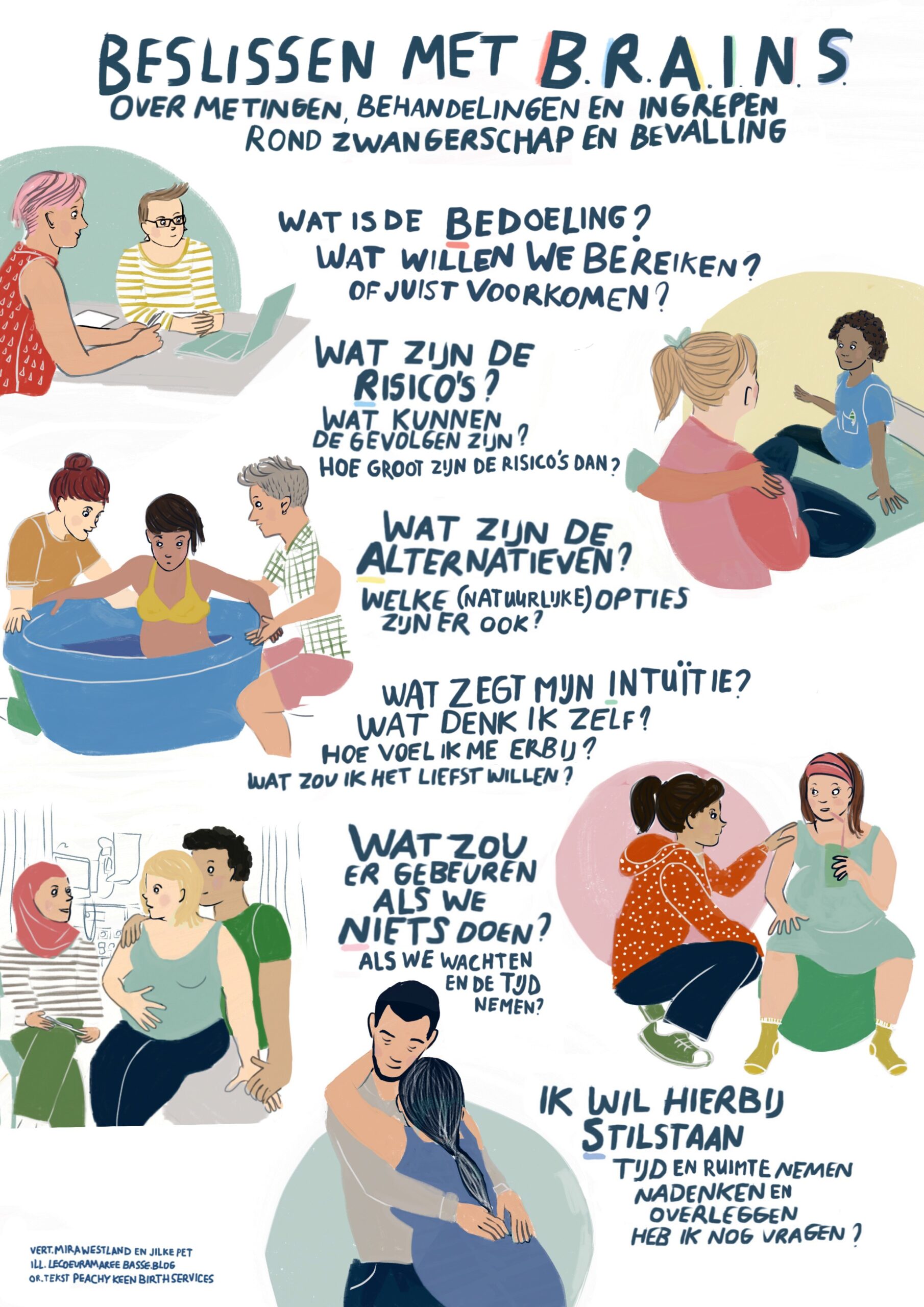
B = Benefits. What is the purpose of the proposal or procedure? What are its benefits?
R = Risks. What are the risks of the procedure? Think about the absolute risk. A doubling of the chance sounds like a lot. But if it goes from 0.1% to 0.2%, the absolute risk is still small.
A = Alternatives. What other options might there be for the problem or procedure? Is there, for example, another position that could help, more rest, more time?
I = Intuition. What does your gut feeling say? What suits you?
N = Nothing. What happens if we do nothing, or wait and see?
S = Standing still. Can we have a moment to think or talk it over? Can we get more information?
A positive birth experience really is possible!
Giving birth is an intense experience. It can be beautiful, hard, special, painful, frightening, transformative and all of those things at once. But in the end, your body is made to give birth. Your body knows what to do, and you can trust that. Just as you can assume that every care provider has the same goal: offering safe and genuine care for you and your baby.
So make sure you know your rights, how the birth process works, and that you have realistic expectations about it. And how you can communicate about this with your care providers in a positive, respectful way. Because when you’re the one making the decisions about your body and your baby, you give birth with inner strength and from a place of control!
Love, Iris
Could you use some help with this?
Could you use a little help with this? Bring in a birth coach. Would you rather not have to worry about any of this during the birth? Then bring in a doula.
Curious how I can support you and your partner during your pregnancy and the birth of your baby (or babies)? Book a free introductory chat.
I look forward to meeting you!